How AI search tools decide which local businesses to recommend, and what you can do about it
A few years ago, a customer searching for a plumber, a winery, or a wedding photographer typed a few words into Google and scrolled through results. Now a growing number of people ask ChatGPT, or read the AI-written summary at the top of Google, and get a short answer that names a few businesses.
If your business isn’t one of them, those customers never see you.
I’ve built websites on the Central Coast for over twenty years. Here’s how these AI tools decide who to mention, what you can do to improve your chances, and where the honest limits are.
AI search tools (ChatGPT, Perplexity, Claude, Google’s AI Overviews) try to give one clear answer instead of a list of links.
To recommend a business, they need to understand it: what you do, where you do it, and why you’re credible.
The basics of local search still matter. Your Google Business Profile, reviews, and consistent information are the foundation.
Nobody can guarantee a recommendation, but clear information and a well-built site improve your odds.
Local search used to be about ranking in the Google Map Pack, the map and top three listings that appear for searches like “plumber near me.” That still matters, a lot.
What’s new is a second layer. AI tools summarize and recommend, and they pull from many sources: your website, your Google Business Profile, review sites, directories, and local news. The businesses that get mentioned tend to be the ones about which the information is clear, consistent, and easy to find.
Think of it as an extension of good local SEO, not a replacement.
When a customer asks, “Who’s the best vineyard photographer in San Luis Obispo County?”, the AI isn’t looking at a pretty page. It’s trying to answer a few basic questions:
What is this business? (A photography studio, a restaurant, a law firm.)
Where does it operate? (Pismo Beach, Paso Robles, all of SLO County.)
What does it offer? (Specific services, not vague “solutions.”)
Can it be trusted? (Reviews, credentials, consistent information across the web.)
If your website says one thing, your Google listing says another, and your Yelp page has an old address, the picture gets muddy. When everything lines up, it’s much easier for these tools to describe you accurately.
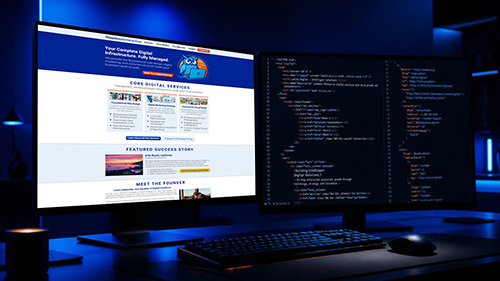
Design matters to human visitors, but AI tools mostly read your site as text and code. Some things can make that harder:
Key information trapped in images. If your hours, services, or prices only appear in a graphic or PDF, they may be missed.
Vague wording. “We craft experiences” tells a machine (and a customer) very little. “Full-service wedding photography in San Luis Obispo County” tells them a lot.
Messy page structure. Pages without a clear headline and logical subheadings are harder to summarize accurately. (This is the same structure that helps screen readers, as I covered in the accessibility post.)
Missing background information. A site that never says who runs the business, where it’s located, or what area it serves leaves gaps.
Get the foundation right. Fully complete your Google Business Profile, including categories, hours, service areas, and photos, and keep it current. Ask happy customers for reviews regularly.
Keep your information consistent. Your business name, address, phone number, and description should match across your website, Google, Yelp, the Chamber of Commerce, and social profiles.
Answer questions directly. Put a clear, one-sentence answer right under each heading, then add detail. For example, under “Wedding photography in Pismo Beach,” start with what you offer, where, and for whom. Real customer questions make good headings, and a plain-language FAQ section on key pages works well.
Name your location and services plainly. Mention the towns you serve and the specific services you offer, in normal sentences. Avoid stuffing keywords. It reads badly and doesn’t help.
Add structured data. This is code that tells search engines, in a standardized format, who you are: your business name, address, hours, services, service area, and links to your official profiles. It doesn’t show up on the page, and most owners never see it, but it’s a clean way to state facts. Have your developer add it, then check it with Google’s Rich Results Test or the Schema Markup Validator. Think of it as helpful, not magic: it supports the other four steps and doesn’t replace them.
Open ChatGPT, Claude, or Gemini and ask the question your customers would ask: “Who are the best [your service] in [your town]?”
Then check:
Are you mentioned at all?
Is the information about you accurate? (Services, location, hours.)
Who is mentioned instead? Look at their websites and profiles to see what they’re doing differently.
Results vary from one tool to the next, and they change over time, so try a few phrasings and check again in a month or two. Treat it as a check-up, not a score.
No one outside the companies that build these tools knows exactly how they choose which businesses to mention, and the systems change often. Anyone who guarantees you’ll be “recommended by AI” is overpromising. What you can do is make your business easy to understand and verify, which is also what good local SEO has always asked for.
What is AEO?
It stands for Answer Engine Optimization, meaning the practice of making your content easy for AI tools to understand and quote. It builds on traditional SEO.
Do I need to give up on regular SEO?
No. Traditional local search still drives a lot of customers, and the same work (clear content, accurate listings, good reviews) helps in both.
Will adding structured data get me recommended?
It can help these tools understand your business, but it’s not a guarantee. It works best alongside a strong Google Business Profile, reviews, and clear content.
Can I do this myself?
Some of it, yes: your Google profile, consistent listings, clearer wording, and asking for reviews are all within reach. The technical pieces, like page structure and structured data, are usually easier with a developer.
Send me your website and I’ll run the test with you, tell you what I see, and point out the fixes that would matter most.
Explore our service packages to see how we work and what it costs.
Get in touch to talk through your site and your goals.

Jay Olson is the founder of Sleepless Interactive, a San Luis Obispo County web design, digital strategy, and commercial photography and video studio serving Central Coast businesses for over twenty years.